
India's first $1 trillion company by market capitalisation (mcap) is achievable by 2032 and HDFC Bank and Reliance Industries (RIL) are seen as lead contenders, ICICI Securities said in a note on Monday. To achieve this, the shares of both the firms will have to appreciate at least 20 per cent annually for the next decade. ICICI Securities believes this is possible if India's gross domestic product (GDP) growth accelerates to 9 per cent per annum and corporate profitability cycle peaks. "Our calculations suggest that India's first $1 trillion mcap stock could emerge by 2032.

From the Sensex pack, Tata Consultancy Services and Infosys fell over 2 per cent each. Hindustan Unilever, Bharti Airtel, Sun Pharma, Power Grid, Bajaj Finserv, HCL Tech, Mahindra & Mahindra, and Tech Mahindra were also among the laggards. Among the gainers, Zomato jumped nearly 5 per cent. Larsen & Toubro, Axis Bank, ICICI Bank, IndusInd Bank and Kotak Mahindra Bank were also among the gainers.

Profits of India's top listed companies have been growing at a faster pace than those of their American peers, but when it comes to revenue growth, the order has reversed recently. The combined net profit of the S&P 500 companies was up 14.1 per cent year-on-year (Y-o-Y) during the trailing 12 months (TTM) ended December 2023, as against 17.4 per cent profit growth logged by the BSE 500 companies in the same period. This is the second consecutive year of faster profit growth for the BSE 500 companies.

I'...additional concessions, such as opening government procurement, reducing agricultural subsidies, weakening patent protections, and allowing unrestricted data flows -- demands India has resisted for decades.'

'We are not incentivising the old tax scheme. These taxpayers will also shift to the new regime after comparison.'
The Economic Survey 2022-23 (FY23), to be presented a day before Union Budget 2023-24 (FY24), is likely to project India's real gross domestic product (GDP) growth between 6 per cent and 7 per cent for FY24, Business Standard has learnt. The broader theme of the Survey could be on how India has dealt with two years of a global pandemic and the ongoing geopolitical disturbance, the strengths and weaknesses that emerged, and what lessons may be learnt. The much-awaited Survey will be the first one by Chief Economic Advisor V Anantha Nageswaran and his team in the finance ministry's economic division.

Analysts are warning of growing risks to the market's sustained momentum, and even to the possibility of consolidation at current levels. Domestically, markets are grappling with several challenges, including a slowing economy, as indicated by the latest GDP data for the July-September (Q2) quarter of 2024-25 (FY25), sticky inflation, fluctuations in the rupee, waning consumption, and high interest rates.

Retail inflation dipped marginally to a nearly six-year low of 3.34 per cent in March due to a decline in prices of vegetables and protein-rich items. The Consumer Price Index (CPI) based inflation was 3.61 per cent in February and 4.85 per cent in March last year.
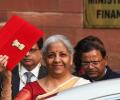
'... that it once again shies away from renewing its commitment to strategic divestment,' points out A K Bhattacharya.

Moody's expected economic activity to pick up in 2020 and 2021 to 6.6 per cent and 6.7 per cent, respectively.

India's services sector growth recorded another month of robust expansion in July, albeit at a slightly slower pace than in June, largely supported by robust demand conditions and investment in technology, a monthly survey said on Monday. The seasonally adjusted HSBC India Services Business Activity Index was at 60.3 in July, down only fractionally from 60.5 in June. In the Purchasing Managers' Index (PMI) parlance, a print above 50 means expansion, while a score below 50 denotes contraction.

BSE-listed companies' market capitalisation reached Rs 197.7 trillion on January 21, against India's nominal GDP of Rs 190 trillion during 12 months ended December 2020.

Every patriot should learn from our history and recognise that celebrating size will neither negate nor obscure the huge economic challenges that India faces, asserts Rathin Roy.

Clawing the economy back to an 8 per cent growth path will require bringing savings and investment rates closer to 35 per cent on a sustained basis, which were 30.2 and 29.6 per cent, respectively, in FY22, according to a report. As per India Ratings, a large part of investments will have to be in infrastructure, which can help revive private investments by easing supply constraints and offset the weakening of external demand due to global headwinds. Higher investments will have to be accompanied by higher domestic savings to keep the savings-investments gap under check.

Shares of state-owned bank stocks were under pressure on Monday due to muted deposit and credit growth numbers reported by these lenders in the October-December quarter (Q3) of 2024-25 (FY25). The Nifty PSU Bank index was down 4 per cent, with Union Bank of India emerging as the biggest loser as its shares fell 7.5 per cent to close at Rs 114.7, followed by a 5.7 per cent drop in shares of Bank of Baroda (BoB) to Rs 228 and a 4.7 per cent slide in shares of Bank of India to Rs 99.8 on the National Stock Exchange.

The RBI on Wednesday slashed key interest rate by 25 basis points, for the second time in a row, to support a shuttering economy hit by reciprocal tariffs imposed by the US. Following the rate cut, the key policy rate eased to 6 per cent providing relief to home, auto and corporate loan borrowers.

As India faces slowing economic growth, HSBC Global Research has downgraded the Indian stock market outlook from "overweight" to "neutral". In a report, the global financial services firm said profits at India Inc appeared to have softened while valuations are elevated. After annualized growth of 25 per cent in recent years, profits appear to have softened while valuations are elevated at 23x forward earnings.

From the 30-share pack, Adani Port, Bharti Airtel, Asian Paints, IndusInd Bank, Bajaj Finserv, Reliance Industries, Infosys, UltraTech Cement, HDFC Bank, HCL Technologies and ICICI Bank were among the laggards. Tata Motors, Axis Bank, Maruti, Larsen & Toubro, ITC and Tata Steel were among the gainers.

S&P Global Ratings on Wednesday upgraded India's sovereign rating outlook to positive from stable while retaining the rating at 'BBB-' on robust growth and improved quality of government expenditure. S&P said it could upgrade India's sovereign rating in the next 2 years if the country adopts a cautious fiscal and monetary policy that diminishes the government's elevated debt and interest burden while bolstering economic resilience.

While China's economy may very well outrace the combined euro zone by the end of this year, India is likely to jump over Japan's economy, according to a latest report by the Organization for Economic Cooperation and Development (OECD).

After a contraction in the current financial year, India's economy is forecast to bounce back with a sharp growth rate of 9.5 per cent next year provided it avoids further deterioration in financial sector health, Fitch Ratings said on Wednesday. The coronavirus pandemic will lead to shrinking of the already slowing economy in 2020-21 that started in April. Fitch Ratings forecast a 5 per cent contraction in the GDP in the ongoing financial year.

India's current account deficit (CAD) may dip further in the March quarter of FY24 as pressure from the negative net exports during the January-March period eased to an 11-quarter high. A part of the gross domestic product (GDP) data, net export- which is usually negative for India - captures the difference between exports and imports of both goods and services, while the CAD data, released by the Reserve Bank of India (RBI), also factors in private transfer receipts.

The ideal time to invest in sector funds, is during a downturn so that investors can capitalise on a turnaround in 1.5 to 2 years.

India, the world's fifth largest economy in the world, is likely to overtake Japan to become the world's third-largest economy with a GDP of $7.3 trillion by 2030, S&P Global Market Intelligence said in its latest issue of PMI. After two years of rapid economic growth in 2021 and 2022, the Indian economy has continued to show sustained strong growth during the 2023 calendar year. India's gross domestic product (GDP) is expected to grow 6.2-6.3 per cent in the fiscal year ending in March 2024, being the fastest-growing major economy this fiscal year.

The most striking features of this Budget was its focus on simplification and improving the ease of doing business in India, asserts Kaku Nakhate.

Gold seems to be losing its glitter in India due to a rise in prices. Demand in Q2CY24 was 149.7 tonnes - a 5 per cent drop compared to 158.1 tonnes in the same period last year, according to a report by the World Gold Council (WGC). Demand by value in April-June 2024 stood at Rs 93,850 crore, up by 14 per cent compared to Rs 82,530 crore in the same period last year.

Under capital expenditure, Rs 48,614 crore has been set aside for aircraft and aero engines while Rs 24,390 crore has been allocated for the naval fleet.

With its age-old fascination for education, southern states have done better than the North. Start-ups, IT hubs, and industry majors setting up shop have changed the face of the South. Nearly 79% of global offices set up by international conglomerates in India are in the South. Almost 46% of tech unicorns are from the South. The GDP per person in the South is 4.2 times higher than the North. None of these indicators can be ignored by any central government, whatever the political compulsions, notes Ramesh Menon.

'Inflation is not good for industry. Nor for the economy as a whole.'

With this, Prime Minister Narendra Modi has also sent a strong message to ally, Janata Dal-United President and Chief Minister Nitish Kumar, that their partnership remains intact and that they will be formidable partners at the hustings.
'As the Budget has taken some measures to spur growth, similar action from the MPC may be expected.'

India's GDP may turn positive at 1.3 per cent in the third quarter of 2020-21, having witnessed contraction in the previous two quarters due to the coronavirus pandemic, as the number of cases is falling and public spending has started rising, according to a report. The government will release the GDP numbers for the October-December quarter of the current fiscal on Friday. Projecting that the gross domestic product (GDP) may have returned to the black in the last quarter of the calendar year 2020, DBS Bank in the report said the full-year growth in real terms may be at a negative 6.8 per cent.

Fitch Ratings on Tuesday said the FY25 Budget demonstrated the government's ongoing commitment to reducing fiscal deficit and ensured policy continuity during the NDA government's new term. Finance Minister Nirmala Sitharaman on Tuesday presented the first Budget of the Modi 3.0 government in which she revised the deficit target for current fiscal lower to 4.9 per cent of the GDP, from 5.1 per cent projected in the interim Budget.

Niti Aayog CEO Amitabh Kant said only farm revolution can make it possible. He also stressed on scrapping Agriculture Produce Marketing Committee and some old laws like Essential Commodites Act, which restrict movement of farm produces.

This will be the first full-year Budget of the BJP-led National Democratic Alliance government since it came to power for a third consecutive term in July last year.

The share of total health expenditure as part of the gross domestic product (GDP) went down to 3.3 per cent in 2017-18 from 3.8 per cent in the previous two years, according to the national health account data released on Monday by the health ministry. The share of government expenditure as part of total expenditure as well as GDP has gone up from from 3.78 per cent to 5.12 per cent between 2013-14 and 2017-18, which could also explain a decline seen in out of pocket expenditure in 2017-18. Health ministry also emphasised the increase in the government health expenditure as part of the total GDP from 1.15 per cent in 2013-14 to 1.35 per cent in 2017-18.

The finance minister, in her Budget speech, should focus more on what she is directly responsible for, rather than on programmes where her role is largely supportive, notes Nitin Desai.

FY17 GDP growth faces cash crunch heat

The Centre's fiscal deficit at the end of the first seven months of financial year 2024-25 touched 46.5 per cent of the full-year target, government data showed on Friday. In absolute terms, the fiscal deficit -- the gap between government's expenditure and revenue -- was at Rs 7,50,824 crore during April-October period, according to data released by the Controller General of Accounts (CGA). The deficit stood at 45 per cent of the Budget Estimates (BE) in the corresponding period of 2023-24.

'As we navigate uncertain waters, a conservative approach to largecap investing could provide a strategic advantage.'
